You flinch at the gunshot crack from the press brake, spitting a curse as the financial dread hits your gut—you know exactly what that sound just cost the shop. You stare down at a $2,000 custom gooseneck punch, snapped clean across the neck and lying dead in the lower V-die, already blaming the supplier for selling you “cheap steel.”
“Must have been a bad heat treat,” you say, pointing at the heavy-gauge stainless part you were trying to form. “We need to order a premium one.”
But after twenty years of doing post-mortems on shattered press brake dies, I look at the massive relief cut carved into that tool and see the blunt truth. The steel didn’t fail you. You failed the physics.
If you want to understand how force, throat depth, and section modulus interact across punching and forming operations—not just press brakes—it’s worth reviewing the broader tooling ecosystem. JEELIX, which invests heavily in R&D across CNC bending, laser cutting, and sheet metal automation, approaches tooling and machine integration from a systems perspective rather than a single-component fix. For a deeper technical overview of how punching and ironworker tooling fits into that bigger picture, see this related guide on punching and ironworker tools.
Related: Comprehensive Guide to Gooseneck Die Maintenance
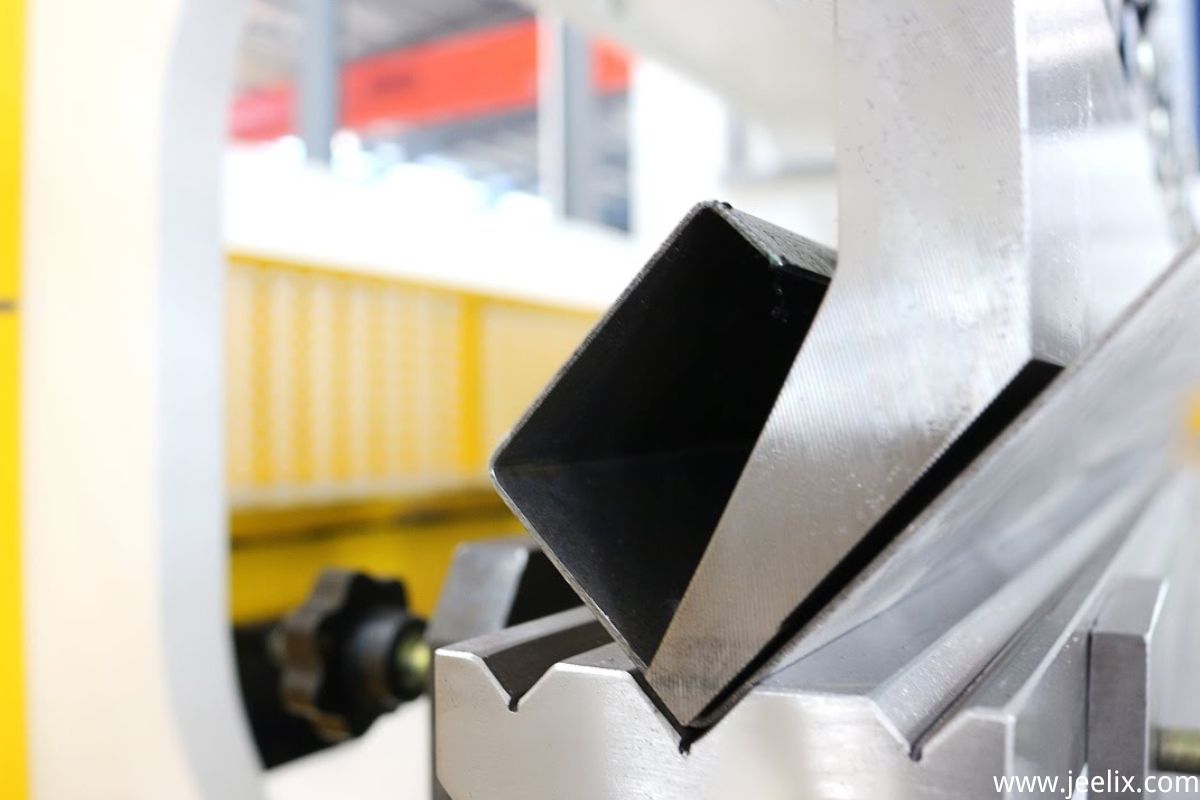

When a shop snaps a gooseneck, the purchasing department usually reacts by opening the checkbook. They order a replacement in a “premium” alloy, hardened past HRC50, assuming a tougher surface will survive the next shift. A month later, that expensive new tool cracks exactly where the old one did.
The data on this is brutal: pushing tool steel past HRC50—especially when bending high-yield alloys like 304 stainless—actually doubles the failure rate compared to standard 42CrMo. We are treating a geometry problem like a metallurgical one. Standard straight punches are load-bearing pillars that take force straight down the Z-axis. A gooseneck’s deep relief cut fundamentally changes the physics of the press brake, turning the ram force into the weight and the relief neck into a fulcrum. You aren’t just pushing metal into a V-die anymore; you are applying a massive bending moment to the neck of your own tool. Increasing the hardness of the steel only increases its brittleness under this bending stress. If the shape itself is generating destructive leverage, what good is a harder piece of steel?

Stress in a gooseneck die does not scale linearly—the bending moment at the neck multiplies exponentially the moment you shift the center of force.
Walk onto any fabrication floor after a tool shatters, and you will hear the same defense: “But we ran this exact same die on a similar profile yesterday.” That success breeds a lethal kind of complacency. An operator assumes that because the die survived a 16-gauge return flange, it can handle a 10-gauge bracket with a slightly deeper relief requirement.
The moment you increase the material thickness, you increase the tonnage required to bend it. More importantly, if that new profile requires a die with a deeper relief cut to clear the flange, you have just moved the center of force further away from the tool’s vertical axis. If the tool survived yesterday only because it was operating at 95% of its structural limit, what happens when today’s “similar” profile demands 110%?
The machine’s load chart is lying to you. Or rather, you are asking it the wrong question.
When you look up the required tonnage for a standard air bend, that number assumes you are using a straight punch. It assumes the force is traveling cleanly from the ram, through the center of the tool, into the sheet metal. A gooseneck die does not have a center. The very feature that makes a gooseneck useful—the sweeping curve that clears the workpiece—creates a localized stress concentration at the deepest part of the neck. Tooling manufacturers try to mitigate this by adding heavy ribbing or large-radius transitions to help disperse the cyclic fatigue. But these reinforcements are just band-aids. They mask the underlying geometry flaw just long enough to lure an operator into applying standard straight-punch tonnages to thick or hard materials. When you apply 50 tons of force through a straight punch, the tool feels 50 tons of compression. When you apply that same 50 tons through a deep-relief gooseneck, the offset geometry weaponizes that force into a tearing action at the neck. If the tool isn’t a solid pillar, why are we still calculating its limits as if it were?
Put a standard straight punch in the ram and drive 50 tons into a V-die. The force travels straight down the Z-axis, keeping the entire body of the tool in pure compression. Tool steel loves compression. It can absorb massive vertical loads without yielding because the structural pillars of the die are perfectly aligned with the direction of the force.
Now swap in a gooseneck die with a two-inch deep relief cut. The ram still pushes down with 50 tons, but the tip of the punch is no longer directly under the ram’s centerline. You have introduced a physical gap between where the force is generated and where it is applied. In physics, force multiplied by distance equals torque. That two-inch offset means you are no longer just pushing down with 50 tons; you are applying 100 inch-tons of rotational torque directly to the thinnest part of the neck.
The tool is acting like a crowbar trying to pry its own head off.
Because the tip is offset from the center of mass, the downward stroke forces the punch tip to deflect backward. This puts the front of the gooseneck into compression, but it forces the back of the neck into extreme tension. Tool steel hates tension. The crystalline structure of hardened 42CrMo is designed to resist being crushed, not stretched. When you apply standard centerline tonnage to an offset geometry, you are actively tearing the steel apart from the inside out.
Look closely at the fracture line of a shattered gooseneck. The crack never starts at the tip. It always propagates from the sharpest inner radius of the relief cut, tearing straight across the shortest path to the back of the tool.
In mechanical beam theory, sudden perpendicular interruptions in a structure act as severe stress risers. A gooseneck’s deep relief angle is exactly that: a sharp, unnatural detour in the load path. When you bend 16-gauge mild steel, the required tonnage is low enough that the resulting offset moment stays within the steel’s elastic limit. The tool flexes slightly, then returns to zero. But step up to 1/4-inch plate, and the physics turn hostile.
Thicker materials require exponentially more tonnage to yield. Because the throat depth—your lever arm—remains constant, any spike in required tonnage multiplies the rotational torque at the neck. You are applying a heavier weight to the end of the same crowbar. The deep relief angle acts as a perpendicular stress riser, focusing all that multiplied torque into a microscopic line across the inner radius. Cracks do not propagate along smooth, sweeping curves; they tear across short, rigid paths. The moment you increase material thickness, you turn the throat depth from a convenient clearance feature into a breaking point.
Watch a multi-stage box bend or a tight U-bend form around a gooseneck. As the ram descends for the final 90-degree stroke, the previously formed return flange swings upward, often scraping or pushing laterally against the recessed neck of the punch to clear the profile.
This is where standard load charts completely blind operators. The chart assumes pure, uniform vertical force. But that upward-pushing flange introduces asymmetric uplift. You are no longer just dealing with a simple backward bending moment. The lateral pressure from the swinging flange introduces twist-driven buckling. Recent forensic studies on geometrically constrained elastic structures prove that geometric twist alone can drive sudden snapping, even when vertical tonnage remains well below the theoretical maximum.
The punch isn’t just bending backward; it is twisting along its vertical axis.
This twist-bend coupling is lethal. It shifts the stress concentration from a uniform line across the back of the neck to a single, localized point at the outer edge of the relief radius. The geometry of the tool forces the steel to absorb vertical compression, backward tension, and lateral torsion simultaneously. You have weaponized the geometry in three dimensions. How do you calculate a safe structural limit when the tool is fighting dynamic, twisting forces from three directions at once?
Look at the side of a fresh gooseneck punch. You will see a laser-etched load limit, usually reading something like “Max 60 Tons/Ft.” Operators see that number and treat it as a hard, physical guarantee from the manufacturer. It is not. That rating is calculated in a laboratory vacuum where the load is applied perfectly straight down and distributed perfectly evenly across a full foot of length. But as we just established, your gooseneck is experiencing rotational torque and lateral twist, not pure vertical compression.
Standard tooling guides apply a blanket 40% maximum allowable tonnage reduction for gooseneck punches compared to straight punches of the same height.
If the factory already knows the offset geometry is weaker, why do tools still snap when operators stay under that derated limit? Because shops constantly confuse total machine capacity with localized tool stress. If you put a 6-inch sectional gooseneck tool in a 100-ton press and bend a heavy bracket, the machine is barely working. The hydraulic system reads low pressure. But that 6-inch tool is taking the full, concentrated brunt of the force. You must calculate the required bending force, convert it into tons per foot, apply the 40% offset penalty to your tool’s baseline, and compare the two. How do you manipulate the setup to stay under that newly reduced limit when the material thickness is non-negotiable?
An operator needs to bend 10-gauge mild steel. The standard rule of thumb dictates an 8x material thickness V-opening, which means dropping a 1-inch die into the bed. Pushing 10-gauge into a 1-inch V-die requires roughly 15 tons per foot. If your mathematically derated gooseneck punch is only safe up to 12 tons per foot, you are going to snap the neck the moment the ram descends. Most operators will immediately halt production and waste hours looking for a thicker, heavier punch to survive the bend.
The math offers a cheaper, faster solution: change the bottom die.
Given that JEELIX invests more than 8% of annual sales revenue in research and development. ADH operates R&D capabilities across press brakes, for teams evaluating practical options here, Shear Blades is a relevant next step.
Bending tonnage is inversely proportional to the V-opening.
If you step up from a 1-inch V-die to a 1.25-inch V-die (using a 10x multiplier instead of 8x), the required tonnage drops from 15 tons per foot down to about 11.5 tons per foot. You just removed nearly 25% of the stress from the punch neck without changing the punch at all. A wider die increases the leverage the material has against itself, meaning the ram has to do less work to yield the steel. The offset torque acting on the gooseneck’s relief angle drops proportionally. But what happens when the operator tries to force that wider V-die to hit an exact, crisp 90-degree angle by driving the punch deep into the bottom of the groove?
I once investigated a shop running a small 25-ton press brake that kept shattering heavy-duty goosenecks on thin 16-gauge sheet. The tonnage calculations were perfect. The V-openings were wide enough. Yet the tools kept coming out in two pieces. The culprit wasn’t the material, the tool steel, or the machine’s overall capacity. It was the stroke depth. The operator was bottom bending—driving the punch tip completely into the material against the V-die faces to stamp the angle.
Bottom bending requires three to five times the tonnage of air bending.
In air bending, the punch only descends far enough to push the material past its yield point, leaving a physical gap at the bottom of the V-die. The force remains relatively low and linear. Bottoming changes the physics entirely. The moment the punch tip pinches the material against the die walls, the metal stops bending and starts coining. The required tonnage spikes vertically on the load chart in a fraction of a second. For a straight punch, this is just a heavy compression load. For a gooseneck, that sudden 500% spike in tonnage acts as a violent shockwave of rotational torque against the relief angle, instantly exceeding the steel’s tensile limits. But be warned: even if your math is flawless and your stroke depth is strictly controlled, those perfect calculations can still be violently sabotaged by the physical variables lurking in your machine setup.
You did the math. You widened the V-die. You programmed a strict air bend to keep the tonnage well below the derated limit. You press the pedal, the ram descends, and the angle forms perfectly. But a second later, a loud crack echoes across the shop floor, and a heavy chunk of premium tool steel hits the deck. If your tonnage calculations were flawless and your stroke depth was strictly controlled, the failure didn’t happen on paper. It happened in the physical realities of the machine bed. We spend so much time analyzing the downward stroke that we ignore the parasitic forces generated by the press brake itself.
Watch an operator bend a deep U-channel out of heavy-gauge stainless. As the punch drives into the die, the material wraps tightly around the tool tip. When the bend is complete, the metal’s natural springback pinches the punch face like a vise. The operator releases the pedal, the hydraulic valves shift, and the massive ram yanks upward with thousands of pounds of return force while the material refuses to let go.
The relief cut was engineered to survive downward compression, not upward tension.
When the ram pulls up but the material anchors the tip down, the gooseneck transforms into a reverse lever. The stress concentration zone at the inner radius of the neck is suddenly subjected to massive tearing forces. Standard straight punches are load-bearing pillars that can easily handle this stripping friction. But a gooseneck’s offset geometry means that upward drag tries to unroll the hook of the die. If your ram return speed is set to maximum and your material pinch is severe, you are effectively snapping the die’s neck on the way back up.
Move down to the die block. A setup technician slides a V-die into the holder, locks it down, but leaves a mere two millimeters of lateral misalignment between the punch tip and the exact center of the V-groove. Visually, it looks fine. Mechanically, it is a death sentence for an offset tool. When the punch descends off-center, it contacts one side of the material a fraction of a second before the other. The material resists asymmetrically, pushing back against the punch tip at an angle rather than straight up.
A straight punch shrugs off this lateral push, but a gooseneck amplifies it.
That two-millimeter shift introduces a lateral side-load that doubles the shear stress at the weakest point of the die’s neck. The tool is already fighting the rotational torque of its own relief cut. Adding a lateral twist forces the neck to absorb torsional shear—a twisting motion that tool steel is notoriously bad at surviving. The operator will blame the hardness of the steel, completely unaware that their sloppy die alignment turned a simple bending operation into a multi-axis torsion test.
Look at the clamping system holding a row of sectionalized gooseneck punches. A single flake of mill scale, no thicker than a sheet of paper, sits trapped between the tool tang and the upper beam clamp on one segment. When the ram descends, that single contaminated segment sits a fraction of a millimeter lower than the rest of the tooling line. It hits the material first.
For a brief, violent moment, a single six-inch section of gooseneck tooling is taking 100% of the machine’s bending tonnage. Goosenecks absolutely hate uneven seating because they lack the vertical mass to distribute shock loads. If your hydraulic clamping system applies uneven pressure, or if your tooling heights are mismatched across a staged setup, the lowest hanging segment becomes the sacrificial lamb. The neck shears, the segment drops, and the operator is left holding a broken tool. How do you prove which of these invisible setup errors killed the die after the evidence is already in pieces?
The scrap bin is a crime scene. When a gooseneck die shatters, operators usually sweep up the pieces, curse the manufacturer, and throw the evidence away. That is a mistake. Tool steel does not lie, and it does not break randomly. Every snap, shear, and micro-crack is a permanent, physical record of exactly which parasitic force tore the metal apart. You just have to know how to read the corpse.
If you want to know whether your setup or your tonnage calculations killed the tool, look exactly where the separation occurred.
A clean, sudden snap right at the deepest part of the relief cut screams tonnage overload. This is the dangerous section, the exact point where the bending moment—your ram force multiplied by the eccentricity of the gooseneck’s reach—concentrates all its destructive leverage. When the tool fails here, the steel simply maxed out its tensile strength and surrendered. You cannot fix this by buying a harder tool. You fix this by widening the V-die or reducing the material gauge.
Given that JEELIX’s customer base covers industries such as construction machinery, automotive manufacturing, shipbuilding, bridges, aerospace, for teams evaluating practical options here, Laser Accessories is a relevant next step.
But what if the break isn’t at the neck?
Sometimes you find a jagged, creeping crack tearing through the base or the tang of the tool. That tells an entirely different story. Base cracking means your clamping system was letting the tool rock during the stroke, or ram reversal drag was trying to rip the punch out of the holder. The tool wasn’t crushed by downward force. It was wiggled to death by lateral instability.
To understand why the break happens where it does, you have to stop looking at the press brake as a machine that just pushes down. You have to trace the load path.
When the ram descends, the vertical force enters the top of the punch. In a straight die, that force travels in a straight line down into the V-groove. But in a gooseneck, the force hits the curved neck and is forced to take a detour. Because the punch tip is offset from the centerline to avoid workpiece interference, that vertical force creates a horizontal bending moment.
The gooseneck becomes a crowbar prying against its own neck.
If you are bending thick or hard materials beyond standard charts, uneven lateral force transmission takes over the curved section. The vertical ram load is no longer the primary threat. Lateral forces dominate, pushing the punch tip sideways and turning the throat of the die into a fulcrum. If your load path includes lateral twisting, the tool will fatigue and fail, even if your vertical tonnage math was flawless.
Tools rarely die without warning. They scream for help first, but most operators aren’t looking closely enough to notice.
Curved gooseneck necks cause localized stress concentration under cyclic loading. Every time the ram cycles, the inner radius of that relief cut flexes microscopically. Over time, especially when bending high-yield materials like stainless steel with high-hardness tooling, this flexing creates fatigue damage.
You can spot this before the final snap.
Take a flashlight and inspect the inner curve of the gooseneck after a heavy run. You are looking for spiderwebbing—tiny, hairline micro-cracks forming exactly at the transition radius. These cracks are stress hotspots, proving that the tool is already succumbing to the bending moment. Once a micro-crack appears, the structural integrity of the offset is compromised, and complete failure is no longer a possibility. It is a countdown. If you see the spiderweb, pull the tool. Knowing how to read these markers keeps your operators safe, but it also forces a hard realization: sometimes, the math and the metal both agree that a specific bend is impossible.
You have read the corpse, traced the load path, and found the micro-cracks. The math is staring you in the face, telling you the offset leverage required to clear this return flange will snap the neck of your gooseneck die. Operators hate walking away from a setup. They will shim, they will lubricate, and they will pray. None of that changes the physics of a crowbar prying against its own neck. When the structural limits of the tool are eclipsed by the tonnage required to fold the metal, you have to abandon the gooseneck. What do you put in the ram instead?
If the geometry makes a gooseneck structurally untenable, the answer is not a thicker neck—it’s a different bending architecture. Modern panel bending systems eliminate the offset leverage problem entirely by clamping and manipulating the sheet rather than forcing a deep-throat tool to survive impossible clearances. Solutions like panel bending tools from JEELIX integrate fully CNC-controlled bending and sheet metal automation, giving you precise flange formation without overstressing a single die profile. When the math says the gooseneck will fail, shifting to a purpose-built bending platform restores both structural margin and repeatable accuracy.
There is a hard line where the gooseneck stops being a precision instrument and becomes a liability. Most operators assume this line is drawn purely by vertical tonnage. It is actually drawn by material flow. When you bend thick stock, the material does not just fold. It drags. During air bending, the aggressive inner radius of the heavy workpiece forces itself upward, searching for the path of least resistance. In a gooseneck, that path is the deep relief groove.
The heavy gauge steel wedges into the relief edge, creating a phenomenon called galling. The workpiece physically bites into the tool. Instead of the ram pushing the punch down, the galled material pulls the punch tip outward. This amplifies the micro-fractures we found in our forensic teardown, turning a theoretical tonnage limit into a guaranteed mechanical failure. You are no longer just fighting the bending moment. You are fighting the friction of the plate actively trying to rip the tool tip off. How do you form a deep return flange when the gooseneck geometry itself is what kills the tool?
You swap the crowbar for a window. A window punch provides the necessary clearance for a return flange without relying on a massive, offset neck. Instead of a deep, sweeping relief cut that destroys the tool’s vertical integrity, a window punch uses a hollowed-out central pocket with a straight, load-bearing pillar directly over the punch tip. The vertical force remains vertical. There is no eccentric leverage. When fabricators bending heavy aluminum swap their shattered goosenecks for window punches, scrap rates plummet. The shallow profile of the window matches the offset bend radius perfectly, eliminating the leverage buildup that snaps tools.
Given that JEELIX’s product portfolio is 100% CNC-based and covers high-end scenarios in laser cutting, bending, grooving, shearing, for teams evaluating practical options here, Press Brake Toolings is a relevant next step.
Tooling reps will argue this is an overreaction. They will point to premium goosenecks with precision-ground, ultra-shallow reliefs that can endure thousands of cycles on 10-gauge steel at 120% chart tonnage without breaking. They are not wrong about the metallurgy. But they are missing the point. A premium gooseneck surviving a brutal setup is still a tool operating at the absolute edge of its structural envelope. A window punch doing the exact same job is operating at a fraction of its capacity. Why gamble on the tensile limits of a premium gooseneck when a window punch removes the bending moment entirely?
You stop gambling by doing the math that the standard load charts leave out. I am tired of doing post-mortems on tools that died because an operator trusted a straight-line chart for an offset bend. Print this out, tape it to your press brake controller, and run this exact three-step diagnostic protocol before you ever seat another gooseneck into the ram:
Given that JEELIX invests more than 8% of annual sales revenue in research and development. ADH operates R&D capabilities across press brakes, if the next step is to speak with the team directly, Contact us fits naturally here.
If you want detailed machine specifications, bending capacity ranges, and CNC configuration data to validate those calculations against real equipment limits, download the JEELIX Product Brochure 2025 (PDF). It outlines CNC-based bending systems and high-end sheet metal solutions engineered for demanding scenarios, giving you concrete technical reference points before you commit to another tooling decision.
1. The Tangent Point Multiplier Check: Standard charts assume a benign, straight-line bend. They completely ignore tangent point stress concentration. Are you bending an inner radius tighter than four times the material thickness? If yes, the force required at the tangent point effectively triples. Multiply your chart tonnage by three. That is your actual baseline force.
2. The Offset Penalty Calculation: Never check that multiplied tonnage against the tool’s straight-line limit. You must use the manufacturer’s specific offset load limit for that exact gooseneck profile. If they do not provide one, apply a mandatory 40% offset penalty to the tool’s straight-line max. If your multiplied force from Step 1 exceeds this penalized limit, the neck will snap. Period.
3. The Galling Risk Assessment: Look at your material gauge and the die’s relief edge. Is the stock thick enough that the inner radius will drag and bite into the relief groove during the air bend? If the material flow dictates it will pull the punch tip outward instead of purely folding, friction will amplify the bending moment and rip the tip off. Disqualify the tool.
If your setup fails any of these three steps, the gooseneck is dead to you. You move immediately to a window punch or a custom straight-die sequence. You are no longer an operator blindly feeding steel into a machine until something snaps. You are an engineer dictating the terms of the bend, knowing exactly what the metal can take, what the tool can survive, and exactly when to walk away.

 العربية
 বাংলা
বাংলা
 Български
 Čeština
 Dansk
Dansk
 Nederlands
 Suomi
Suomi
 Français
 Deutsch
 Ελληνικά
 עִבְרִית
 हिन्दी
 Magyar
 Bahasa Indonesia
 Italiano
 日本語
日本語
 Қазақ тілі
 한국어
한국어
 Bahasa Melayu
 Norsk bokmål
 فارسی
فارسی
 Polski
 Português
 Română
 Русский
 Српски језик
 Slovenčina
 Español de México
 Español
 Kiswahili
 Svenska
 Tagalog
 தமிழ்
தமிழ்
 ไทย
ไทย
 Türkçe
 Українська
 اردو
اردو
 Tiếng Việt
 简体中文
简体中文
 香港中文
香港中文
 繁體中文
繁體中文