Watch an experienced operator form a 16-gauge stainless steel enclosure on a conventional press brake. The actual bend takes maybe twelve seconds. The ram descends, the metal yields, and the part is complete. It looks like peak efficiency.
But stand on the shop floor with a stopwatch and account for the forty-five minutes leading up to that bend—the search for the correct segmented punches, the trial bends, the shimming, the scrapped blanks—and the inefficiency becomes obvious.
That unseen forty-five minutes is a tax imposed on every short-run batch you produce. It’s precisely why your shop feels constantly busy while your margins refuse to grow. To truly break free, understanding and optimizing your Press Brake Toolings is the first critical step.
The uncomfortable reality is this: your shop isn’t constrained by how quickly your team can bend a flange. It’s constrained by everything that happens between bends. Manual setup time, scrap, and operator fatigue function like a compounding tax. Every time someone grabs an Allen wrench to tweak the backgauge, you incur a cost. Every time a heavy component requires two operators to flip it, you incur another. Eventually, the effective tax rate becomes unsustainable—and manual Standard Press Brake Tooling simply stops making financial sense.
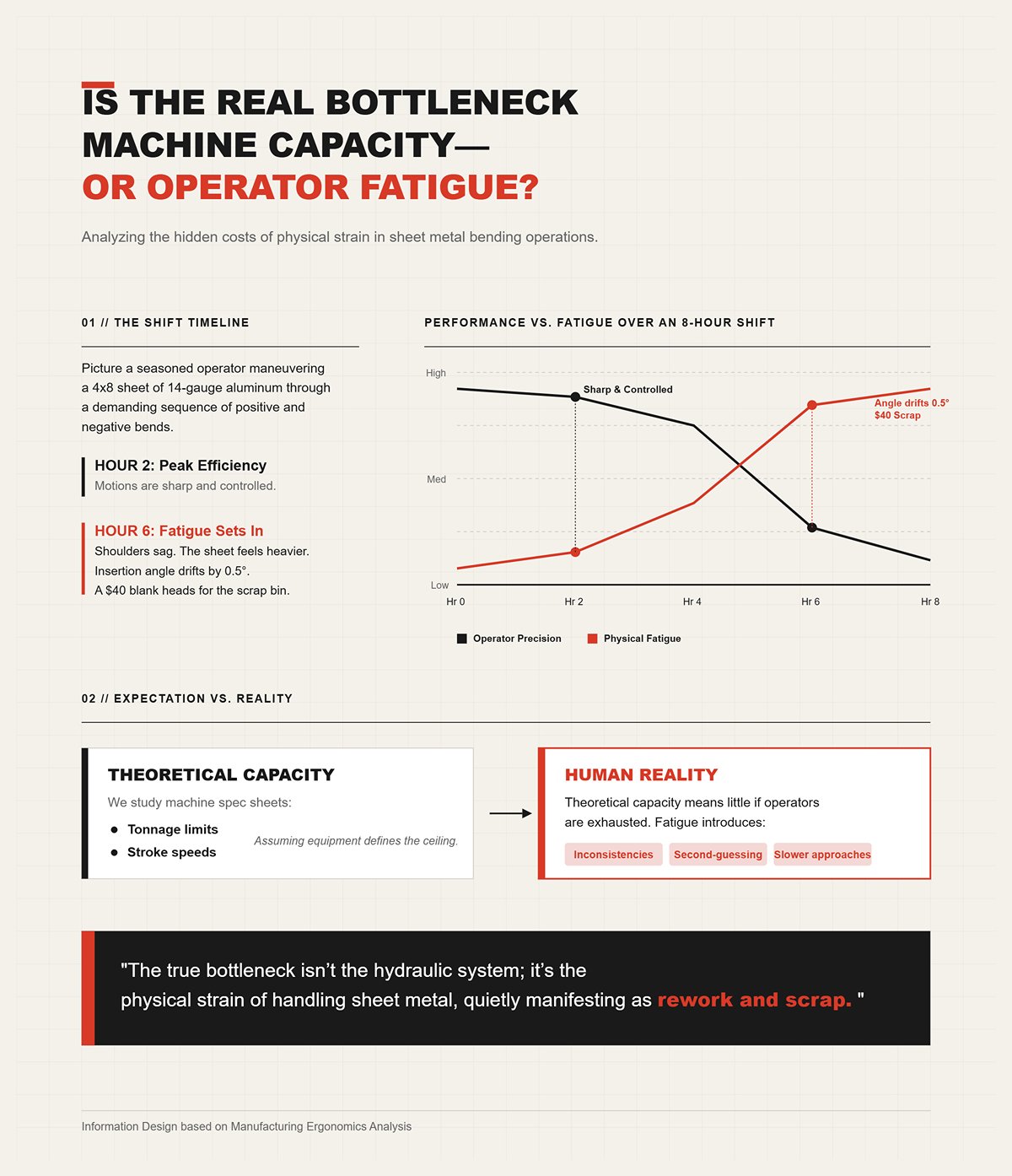
Picture a seasoned operator maneuvering a 4×8 sheet of 14-gauge aluminum through a demanding sequence of positive and negative bends. Two hours into the shift, the motions are sharp and controlled. By hour six, shoulders sag. The sheet feels heavier. The insertion angle drifts by half a degree, and suddenly a $40 blank is headed for the scrap bin.
We tend to study machine spec sheets—tonnage limits, stroke speeds—assuming the equipment defines the ceiling. But theoretical capacity means little if the human operators feeding the machine are exhausted. Fatigue introduces subtle inconsistencies. A tired operator second-guesses the backgauge, runs an extra test piece, or slows the ram’s approach. The true bottleneck isn’t the hydraulic system; it’s the physical strain of handling sheet metal, quietly manifesting as rework and scrap.
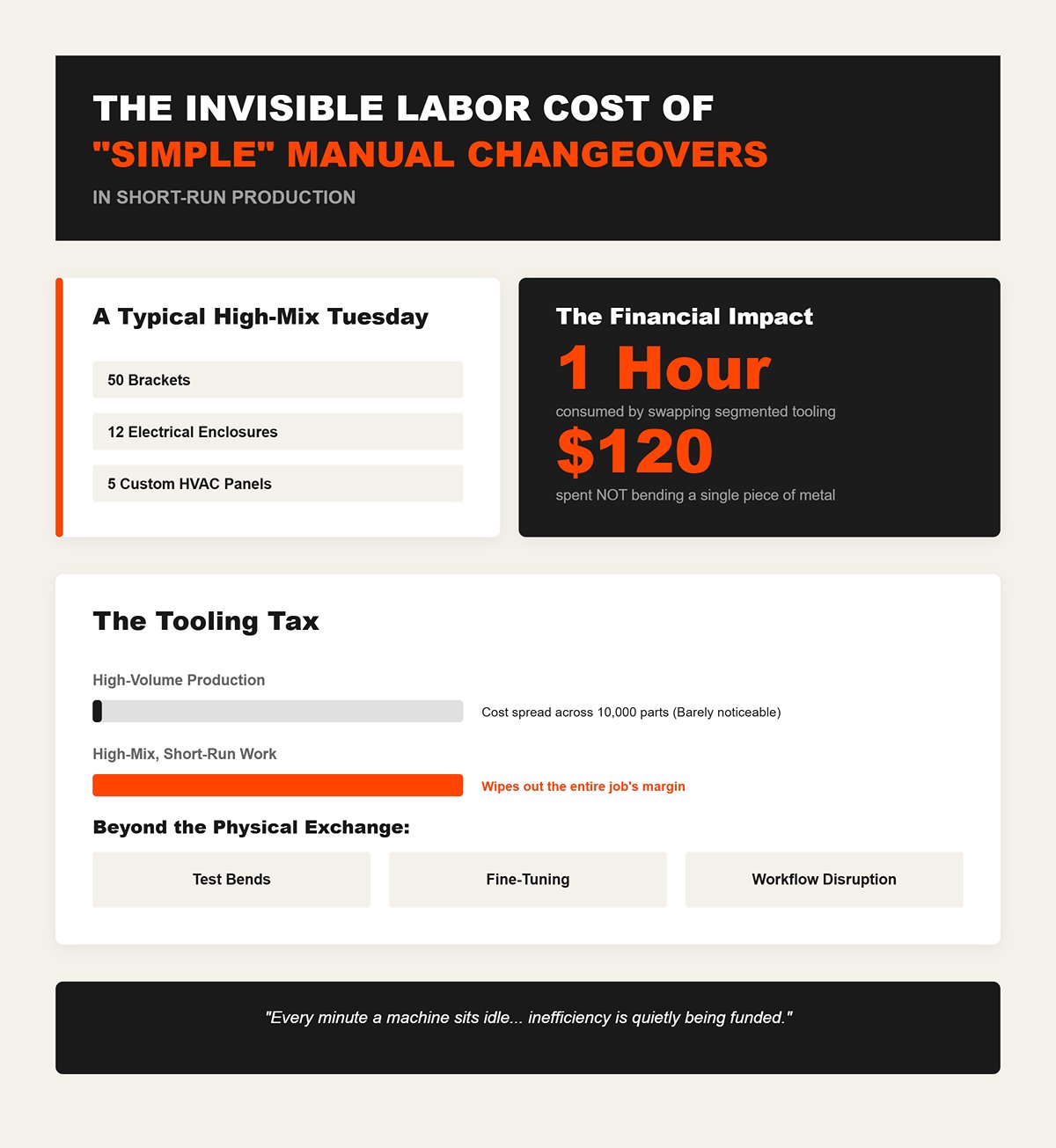
Consider a typical high-mix Tuesday schedule: fifty brackets, twelve electrical enclosures, and five custom HVAC panels. In a conventional setup, swapping out segmented tooling for those three jobs can easily consume an hour. At a shop rate of $120 per hour, that’s $120 spent not bending a single piece of metal.
This is the tooling tax in its most punishing form. In high-volume production, an hour of setup spread across ten thousand parts is barely noticeable. In high-mix, short-run work, that same hour can wipe out the entire job’s margin. Many shop owners label changeovers as “simple” because swapping a punch isn’t technically difficult. But the real cost goes far beyond the physical exchange. It includes the test bends, the fine-tuning, and the disruption of workflow. Every minute a machine sits idle while an operator nudges a die into alignment with a brass hammer, inefficiency is quietly being funded.
A standard hydraulic press brake can complete a ram cycle in under three seconds—blisteringly fast. Yet a closer look at an entire shift often reveals that the machine is actively bending metal less than 20% of the time. Bend speed means nothing if the resulting angle is off target.
Repeatability is the only metric that truly safeguards throughput. With manual tooling, repeatability depends entirely on the operator’s ability to position the part against the stops identically—hundreds of times in succession—despite variations in material springback. If the first part takes ten seconds, but the next takes fifteen because the operator pauses to double-check a flange, then your cycle time isn’t ten seconds. It’s variable—and variability kills efficiency.
Constraint Check: If your most experienced operator calls in sick tomorrow, does your throughput drop by 50%, or does your process stay on track?
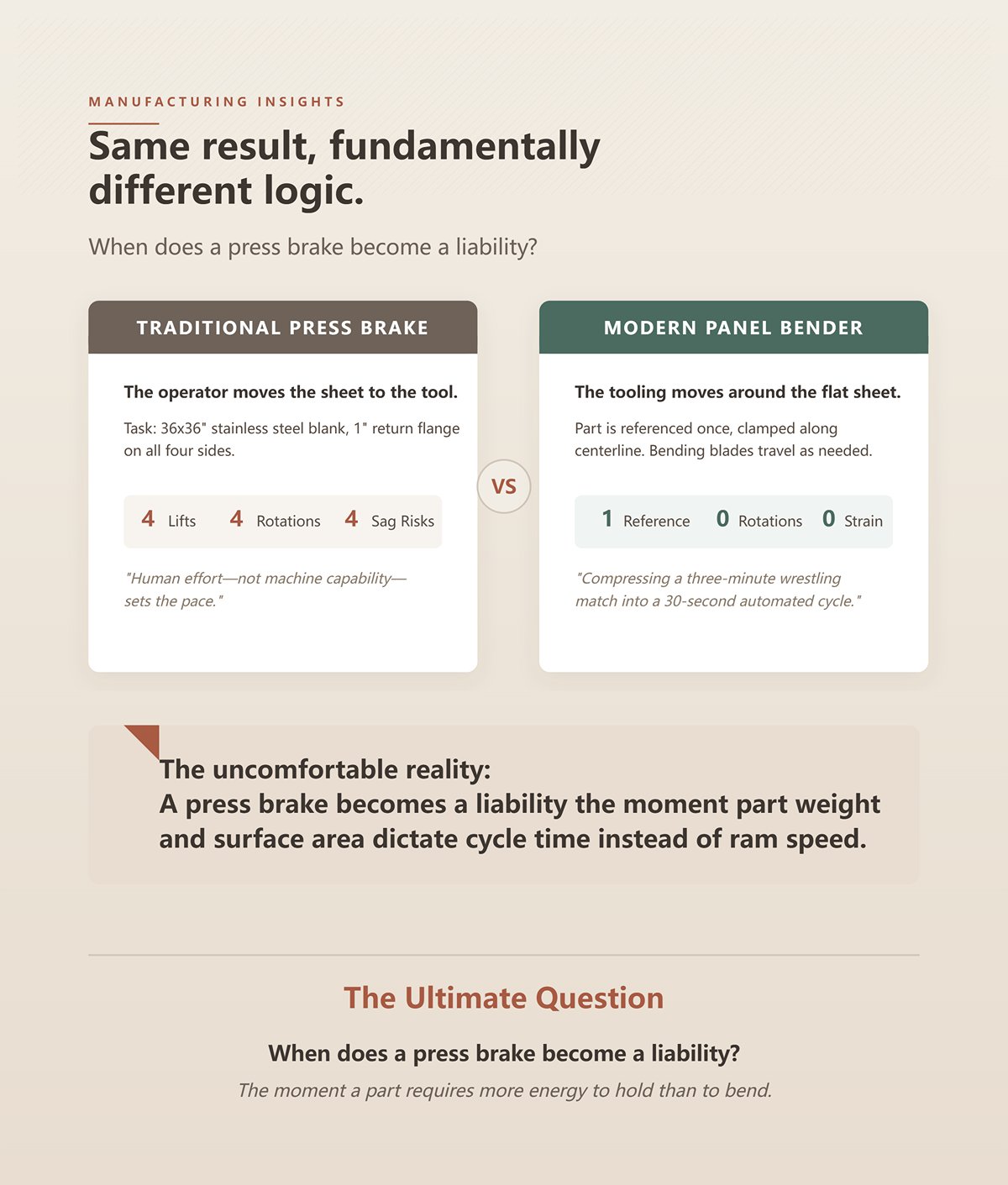
Hand an operator a 36-by-36-inch blank of 16-gauge stainless steel and ask for a one-inch return flange on all four sides. On a traditional press brake, the machine’s logic requires the operator to move the sheet to the tool. They lift the blank, register it against the backgauge, cycle the ram, then physically rotate the entire unwieldy square ninety degrees. Four bends require four lifts, four rotations, and four opportunities for the sheet to sag just half a degree off the backgauge.
The uncomfortable reality is this: a press brake becomes a liability the moment part weight and surface area start dictating cycle time instead of ram speed. We tend to study machine spec sheets—tonnage capacity, stroke length, approach speed—and assume the equipment is the bottleneck. In practice, when forming large panels, the press brake turns the operator into the primary material‑handling system, and human effort—not machine capability—sets the pace.
A panel bender reverses that equation entirely. Rather than forcing the operator to move the sheet through the tooling, it holds the sheet flat and moves the tooling around the sheet. The part is referenced once, clamped along its centerline, and the bending blades travel as needed. The result is the same four-sided pan—but the shift in logic eliminates the operator’s physical strain, compressing what used to be a three-minute wrestling match into a thirty-second automated cycle. So when does a press brake become a liability? The moment a part requires more energy to hold than to bend.
Consider a basic Z-bend or a more intricate offset profile. On a press brake, producing a positive bend immediately followed by a negative bend means pulling the sheet from the die, flipping it completely over, re-registering it against the backgauge, and cycling again. If the part is a 6-foot architectural panel, that flip demands two operators and plenty of floor space. And every time the sheet leaves the backgauge, you pay a tooling tax: the loss of your original reference point.
Panel benders eliminate that tax through their kinematics. Because the sheet remains clamped flat within a manipulator, the upper and lower bending blades simply alternate roles. Need a positive bend? The lower blade sweeps upward. Need a negative bend? The upper blade sweeps downward. The sheet never flips—and, critically, it never loses its centerline reference.
This is where precision begins to compound. Modern panel benders deliver bend-to-bend accuracy of ±0.008 inch and repeatability of ±0.004 inch not only because their servo systems are highly refined, but because they measure material thickness and deformation in real time. The machine automatically compensates for variations that a press brake operator would otherwise chase with shims and test bends. By manipulating the flange instead of flipping the sheet, you remove the human variable from the geometry equation altogether. For complex bends like large radii, specialized Radius Press Brake Tooling can be essential, even on traditional brakes.
Constraint Check: If your current process requires two operators just to flip a part between a positive and negative bend, are you paying for metal fabrication—or for synchronized weightlifting?
| Section | Content |
|---|---|
| Topic | Positive and negative bending: Why manipulating the flange beats flipping the sheet |
| Scenario | In a Z-bend or offset profile on a press brake, producing a positive bend followed by a negative bend requires removing the sheet, flipping it, re-registering it against the backgauge, and cycling again. Large parts (e.g., 6-foot panels) require two operators and significant floor space. Each removal from the backgauge results in loss of the original reference point (“tooling tax”). |
| Panel Bender Advantage | Panel benders keep the sheet clamped flat within a manipulator. The upper and lower bending blades alternate roles: the lower blade sweeps upward for positive bends, and the upper blade sweeps downward for negative bends. The sheet remains in place and maintains its centerline reference. |
| Precision Benefits | Modern panel benders achieve bend-to-bend accuracy of ±0.008 inch and repeatability of ±0.004 inch. They measure material thickness and deformation in real time and automatically compensate for variations, eliminating the need for shims and test bends. |
| Key Insight | Manipulating the flange instead of flipping the sheet removes human variables from the geometry equation and compounds precision. |
| Constraint Check | If two operators are required just to flip a part between bends, are you paying for metal fabrication—or synchronized weightlifting? |
Step into a shop trying to close the automation gap on a tight budget, and you will often find a semi-automated CNC folder. The sales pitch is appealing: you get the folding-beam kinematics of a panel bender without the seven-figure investment. The operator feeds in the sheet, the beam forms the flange, and the machine automatically adjusts the bend angle.
But theoretical capacity means little if human muscle is still driving the process. Semi-automated folders require the operator to manually rotate the part for every new side. You gain the folding motion, yet you keep the same handling burden that slows down a press brake.
Worse still, folders typically lack the tonnage of a press brake and the centerline clamping speed of a true panel bender. The result is a machine that struggles with heavy-gauge material while still depending on an operator to maneuver high-mix panels by hand. Rather than landing in the middle, you often inherit the limitations of both: restricted thickness capacity from the folder and the manual handling burden of a brake. In genuine high-mix production—where complex geometries set the tempo—partial automation only removes part of the bottleneck.
Watch an operator switch from a standard 90-degree flange to a teardrop hem on a conventional press brake. They must unclamp the punch, roll over the tooling cart, install a flattening die, align it, and run a scrap piece to verify the crush. That is 15 minutes of pure setup downtime. Repeat that four times in a shift, and you have sacrificed an hour of productive spindle time to the tooling tax.
The hard truth in high-mix sheet metal is this: your margin isn’t defined by how fast a machine can bend—it’s defined by how fast it can change direction. Automated panel benders solve this with multi-tool kinematics. Rather than swapping out heavy tool blocks by hand, a CNC panel bender uses an integrated tool changer or a universal bending blade system that reconfigures itself in real time. If the next profile requires an offset bend followed by a large radius, the upper and lower blades adjust their pivot points and stroke depths in milliseconds. The sheet remains clamped. The tooling adapts around it. Hem, radius, and offset bends are completed in a single setup—no manual intervention required. For traditional press brakes, achieving similar versatility for complex profiles often requires investing in Special Press Brake Tooling.
When shops analyze multi-axis CNC operations, they often uncover a harsh reality: tightening tolerances on complex geometries can easily double the cost per part. Trying to hold a ±0.005-inch tolerance on a compound flange with a manual setup means test bends, scrap, and endless shimming. It’s tempting to study machine spec sheets—tonnage limits, stroke speeds—and assume the hardware defines the ceiling. But theoretical capacity is irrelevant if the operator is fatigued or forced to estimate material springback by feel.
When complex flanges intersect with software-driven precision, the focus shifts from brute force to predictive control. Modern panel benders measure the tensile strength and thickness variation of the specific 16-gauge sheet clamped in place before executing the final bend. The software calculates the precise overbend required and adjusts the machine’s kinematics in real time.
That said, single-setup automation introduces its own risk. Software accuracy depends entirely on a correctly configured post-processor. If the CAM system’s kinematic model doesn’t align with the machine’s physical constraints—such as axis travel limits or rotation directions—the result isn’t a flawless flange. It’s gouging, wasted cycle time, or even a multi-axis crash. Single-setup automation magnifies programming mistakes just as effectively as it multiplies throughput. But when the post-processor is properly tuned, the machine automatically compensates for material variability that would otherwise demand constant micrometer checks from a highly skilled operator.
Place a conventional press brake beside an automated panel bender and run 5,000 identical electrical enclosures. With a dialed-in setup and a steady operator, the press brake might even win the strokes-per-minute contest. On paper, it looks like peak efficiency. But what happens when the schedule shifts to five enclosures, then twelve HVAC brackets, then three custom stainless fascias? The press brake drops to zero strokes per minute while the operator struggles through three separate tooling changeovers.
In high-mix, low-volume production, raw throughput is a vanity metric. Versatility is what actually drives profitability. A CNC panel bender internalizes the tooling tax. Its multi-tool kinematics can switch from a sharp 90-degree tool to a large-radius profile in the same moment the manipulator rotates the part—effectively reducing setup time to zero. You’re no longer forced to batch jobs just to justify changeovers; you can run parts in the exact sequence the assembly department requires. The result is less work-in-progress inventory and a transformation of high-mix volatility from a scheduling liability into a competitive advantage.
Constraint Check: Are you measuring your shop’s capacity by machine cycle speed—or by the number of distinct, finished parts that actually reach the shipping dock by the end of the shift?
Walk into a shop processing 16-gauge 304 stainless with four manual press brake changeovers per shift. Watch the operator scrap the first two blanks of every setup just to fine-tune the springback. At $45 per blank, plus 20 minutes of setup time per changeover, that operation is quietly losing more than $500 a day before a single conforming part reaches the shipping pallet. This is the tooling tax in its purest form—a compounding penalty applied to every high-mix batch, steadily eroding margins while the machines appear busy. The automation threshold is rarely about producing a million identical parts. It’s about recognizing the precise moment when this daily drain exceeds the cost of a monthly equipment payment.
A 20-year veteran can sense the yield point of 5052 aluminum through the soles of his boots and tweak a manual backgauge on instinct alone. But that veteran retired last year, and the new hire is struggling to maneuver a 40-pound sheet while squinting at a tape measure upside down. The uncomfortable reality is this: manual control is only cost-effective when the person running it is exceptional. When skilled labor is in short supply, operator dependence injects costly variability into your production schedule. An inexperienced operator doesn’t just work more slowly—they second-guess, overbend, and choke the entire assembly flow with rework delays.
We tend to study machine spec sheets—tonnage limits, stroke speeds—and assume the equipment defines our ceiling. But theoretical capacity is meaningless if the human muscles loading the machine are exhausted.
Automated CNC panel benders confront this dependency head-on. By transferring material handling and tool positioning to servo-driven manipulators, and pairing them with intuitive CNC controls, they can reduce operator reliance by as much as 40 percent. The machine measures the sheet, calculates bend allowance, and executes the sequence with precision. The financial case for manual control unravels the moment you are paying skilled wages to produce unskilled scrap. Why keep underwriting a manual process when the true cost per part fluctuates with the operator’s energy level at 3:00 p.m.?
Imagine you’ve quoted a run of 150 complex electrical enclosures. Conventional wisdom says CNC only becomes economical at high volumes, while manual press brakes win on short runs. That logic breaks down in a high-mix sheet metal environment. On a manual brake, holding a ±0.005-inch tolerance on a compound flange demands test bends. Scrap three parts during setup on a 150-piece job, and you have already burned through 2 percent of your material budget. Multiply that across ten different part families in a single week, and the losses escalate quickly.
An automated panel bender comes with a formidable upfront cost—often twice the price of a top-tier press brake. However, its universal bending blade and real-time thickness compensation eliminate the need for test bends altogether. The very first piece off the machine is production-ready. When you compare a $400,000 capital investment to a persistent 3 percent scrap rate on high-value materials—along with the unrecoverable setup time spent dialing in tolerances—the payback window contracts from decades to just a few years. You’re not investing in faster bends; you’re investing in the permanent removal of setup waste. Where else on the shop floor can you effectively purchase a zero-scrap guarantee?
Issuing a purchase order for an automated bending cell delivers an immediate dose of capital shock. Implementation often demands upgrading legacy CAM systems, retraining programmers, and navigating the initial resistance of operators who place more trust in solid steel tooling than in software-driven precision. This transitional friction can delay early returns, making the price tag feel like a weight around the company’s neck during the first two quarters of rollout.
The real return on investment, however, reveals itself in contract stability. Once the tooling tax disappears, throughput becomes mathematically predictable. You know precisely how long a batch of 50 custom fascias will require because setup time is eliminated and scrap is virtually nonexistent. That level of certainty empowers you to compete for demanding just-in-time OEM contracts that manual operations struggle to guarantee without maintaining costly buffers of work-in-progress inventory. Automation absorbs high-mix variability, converting scheduling chaos into dependable revenue.
Constraint Check: If your operation averages more than four changeovers per shift with scrap rates exceeding three percent, is an automated panel bender truly a costly indulgence—or is it the only viable way to safeguard margins in an era of skilled labor shortages? For a detailed analysis tailored to your specific operation, it’s wise to Contact us for a consultation.
Picture taking a pristine, climate-controlled CNC panel bender and setting it down in the middle of a muddy commercial construction site. On a polished concrete floor, surrounded by clean 16-gauge blanks, it embodies peak efficiency. But out in the real world—staring at a stack of 1/2-inch architectural plate that must contour perfectly to a poured concrete retaining wall—that half-million-dollar showpiece quickly turns into a very expensive paperweight. Automation excels under controlled conditions. The field rarely offers them. We spend so much time calculating the ROI of zero-setup bending that we overlook the machine’s physical limits. There comes a point where tooling costs are irrelevant—because the automated system simply cannot perform the task.
We tend to scrutinize spec sheets—tonnage ratings, stroke speeds—as if the machine defines the boundary. Sometimes, however, the real constraint is the zip code. Architectural fabrication often means fitting metal to structures poured, framed, or welded to “field tolerances”—in other words, nothing is perfectly square. When bending heavy structural fascias or custom stair stringers, you rarely have the luxury of measuring on-site, updating CAD files, running the part through a large CNC cell, and shipping it back—only to discover the concrete has settled by an eighth of an inch.
The field requires real-time adjustment. Traditional hydraulic press brakes or heavy-duty portable benders can be hauled onto a job site, powered by a diesel generator, and operated by a fabricator measuring the actual gap—not a theoretical CAD model. You sacrifice factory-level precision for geographic reality. A CNC panel bender is fixed to your shop floor, dependent on flawless inputs to deliver flawless outputs. When the job site itself becomes the variable, factory automation gives way to a skilled operator with a tape measure, a rugged portable brake, and the judgment to bend on the fly.
The uncomfortable reality is that panel benders are engineered for sheet metal—not armor plate. Their mechanical advantage depends on servo-driven blades folding material around a central hold-down beam. Move from 14-gauge stainless trim to 1/2-inch A514 ultra-high-strength steel plate for architectural features, and the underlying physics shift dramatically.
You can’t bend a half-inch steel plate using the same fine-tuned mechanics designed to crease a lightweight electrical enclosure.
Heavy plate demands immense, highly concentrated tonnage and purpose-built V-dies capable of forcing the material to yield without compromising its grain structure. Push a panel bender into this territory, and its own geometry becomes a liability. The automated blades either lack the force to deform the plate properly, or the extreme loads required risk damaging the machine’s intricate internal mechanisms. Heavy-duty press brakes prevail in this arena because their vertical ram design is fundamentally straightforward and brutally effective. There are no complex folding arms—just a hardened steel punch driving into a hardened steel die with hundreds of tons of raw hydraulic power.
Even if your parts technically fall within an automated bender’s processing limits, your facility itself may rule it out. A fully automated bending cell with integrated material-handling towers occupies a substantial footprint. It often requires reinforced concrete foundations to prevent settling, dedicated 480V three-phase power with significant amperage capacity, and a climate-controlled environment to shield sensitive servo systems from dust and debris.
By contrast, traditional press brakes are remarkably tolerant of their surroundings. You can position a 150-ton brake in a dim corner of the shop, connect standard industrial power, and expect it to form heavy plate reliably for decades with minimal upkeep. If your facility is space-constrained, your electrical service is already at capacity, or your capital expenditures are tightly limited, the theoretical throughput of a CNC cell becomes irrelevant. You cannot purchase efficiency with space and power you simply do not have.
Constraint Check: Are you producing delicate, high-mix geometries that truly justify reengineering your entire shop infrastructure—or are you trying to solve a heavy architectural plate challenge with a fragile automated system?
The hard reality is this: equipment catalogs are designed to sell you peak theoretical capacity, while your shop floor lives and dies by minimum real-world throughput. It’s tempting to pore over spec sheets—calculating tonnage limits and stroke speeds as if the machine itself were the bottleneck. But a machine is only a tool. The true constraint is your specific mix of materials, part geometries, and workforce.
A fully automated panel bender might deliver 17 bends per minute with zero manual tooling changes, presenting itself as the ultimate margin booster. Yet if you feed it the wrong parts, you’ve simply invested in a highly efficient scrap generator. To eliminate the tooling tax without installing a half-million-dollar bottleneck, stop asking what a machine can do in isolation. Start asking what is actively eroding your margins on the floor today.
Automation has a hard ceiling—and it’s often measured in thousandths of an inch.
Panel benders shine when folding 14-gauge aluminum or stainless steel into complex parts up to 10 feet long. But if your core work shifts toward 10-gauge or 1/4-inch plate, the delicate, servo-driven blades of a CNC folder simply won’t move the material. Start by mapping your material thickness range. The laws of physics alone may eliminate a panel bender from consideration before you ever glance at the price tag.
Next, examine your part geometry. Panel benders have relatively shallow throat depths compared to the expansive open heights of a traditional press brake. If you’re forming deep electrical enclosures or tall flanges, the machine’s physical architecture can prevent the part from rotating during the bend sequence.
Even standard Z-bends come with strict constraints on an automated folder. To avoid tooling collisions, you typically need a minimum total height of at least 2.5× material thickness and flange lengths of 1.5× thickness. If your average batch consists of 15 highly variable parts with deep box geometries, the “zero setup” advantage disappears—because the part simply cannot rotate inside the machine.
Constraint Check: Are your parts truly thin and flat enough to rotate within a panel bender’s throat, or are you trying to push deep, heavy-gauge boxes through a machine engineered for shallow trim work?
Once the physics make sense, you need to pinpoint the operational drag. Walk out to the bending cell and observe the operator for an hour. If an experienced fabricator is burning 40 minutes tearing down and rebuilding complex staged tooling for a run of 20 parts, your bottleneck is setup time. That’s the real tooling tax—and it’s precisely where a CNC panel bender earns its keep by reconfiguring its tooling in seconds.
But what if setup is quick and the scrap bin is still filling up with parts bent the wrong way or in the wrong sequence?
Then you’re dealing with skill scarcity and geometric complexity. A press brake depends entirely on the operator’s spatial judgment to flip and rotate the blank correctly. An automated bender takes human hands out of the sequence—clamping the part once and executing every positive and negative bend with precision. But a machine’s theoretical throughput means nothing if the people feeding it are exhausted. If your slowdown comes from moving heavy, straightforward parts through a standard 90-degree V-die, automation won’t fix it. A jib crane and a smarter material-handling layout will.
Shops rarely fail from lack of work; they fail from taking on work they can’t digest. When you purchase a machine to solve today’s specific pain point, you lock your capabilities to the present. If your current high-mix, 16-gauge production justifies a panel bender, the investment makes sense. But even the most intelligent, flexible panel benders excel at absorbing high-mix variability only within their physical limits. They can’t overcome fundamental tonnage constraints.

 العربية
 বাংলা
বাংলা
 Български
 Čeština
 Dansk
Dansk
 Nederlands
 Suomi
Suomi
 Français
 Deutsch
 Ελληνικά
 עִבְרִית
 हिन्दी
 Magyar
 Bahasa Indonesia
 Italiano
 日本語
日本語
 Қазақ тілі
 한국어
한국어
 Bahasa Melayu
 Norsk bokmål
 فارسی
فارسی
 Polski
 Português
 Română
 Русский
 Српски језик
 Slovenčina
 Español de México
 Español
 Kiswahili
 Svenska
 Tagalog
 தமிழ்
தமிழ்
 ไทย
ไทย
 Türkçe
 Українська
 اردو
اردو
 Tiếng Việt
 简体中文
简体中文
 香港中文
香港中文
 繁體中文
繁體中文